By Raquel Frattini | Chirgwin
The re-election of Luiz Inácio Lula da Silva as president of Brazil, following a closely contested second round against Flávio Bolsonaro, raises a particularly relevant question for Chile: can two governments with different political orientations deepen economic integration and create new opportunities for businesses?
The answer will depend less on ideological affinities than on the ability of both countries to transform their shared interests into concrete results.
The relationship between Lula and Chilean President José Antonio Kast already offers signs of institutional pragmatism. The two presidents met during this year and, after the election result was announced, Kast called Lula to congratulate him, reaffirming his willingness to work together on economic integration and the fight against organized crime. This is a relevant sign: relations between States must transcend the political differences of their governments.
For businesses, the continuation of the Lula administration makes it possible to anticipate a familiar economic and regulatory direction, although not necessarily one that will be free from changes. Brazil continues to face significant fiscal challenges, high financing costs and the implementation of a far-reaching tax reform. The size of its market and its investment opportunities coexist with a complex legal and administrative system, in which federal, state and municipal powers directly affect business activity.
A concrete example of the outstanding trade challenges is the situation of Chilean salmon in Brazil.
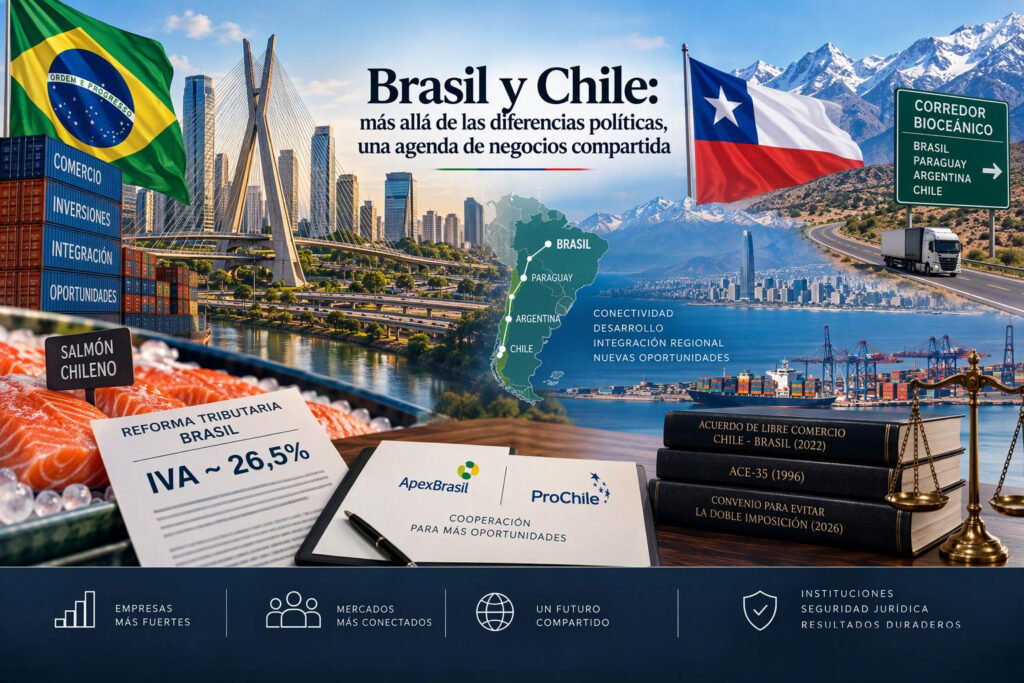
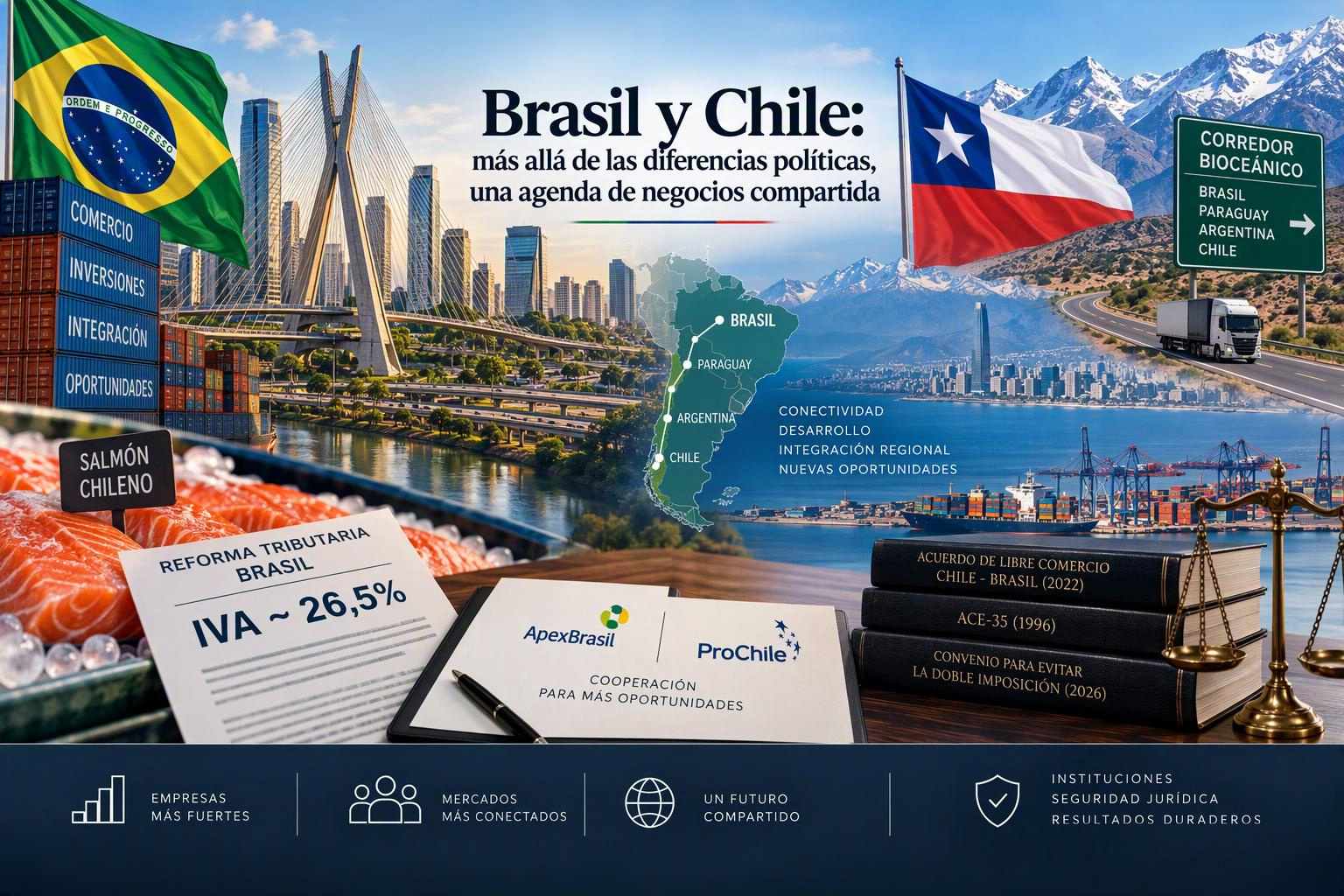
Brazil’s tax reform excluded this product from the food products benefiting from a zero rate under the new VAT system, exposing it to a general tax rate estimated at around 26.5%. Although this is not a tax specifically directed against Chile, the difference in treatment compared with other proteins could affect its competitiveness in one of its main export markets.
Will the new stage in relations between Lula and Kast help reverse this situation? The answer will depend on the ability of the authorities and the private sector to promote solutions within the Brazilian legal framework. The case represents a concrete opportunity to demonstrate that economic diplomacy can help resolve obstacles that directly affect bilateral trade.
Another strategic challenge will be to give the Bioceanic Corridor the importance it deserves.
The project, which will connect Brazil, Paraguay, Argentina and Chile through an overland route between the Atlantic and the ports of northern Chile, represents much more than an infrastructure initiative: it constitutes an opportunity for productive and commercial integration among the four countries. Its development will improve connectivity, strengthen supply chains, attract investment and facilitate access to Asia-Pacific markets. It will be essential for the four governments to embrace it as a shared strategic priority, ensuring political continuity, infrastructure investment and customs and border coordination. New roads will be of little use if they are not accompanied by efficient procedures and rules that facilitate the international movement of goods.
The project also has institutional support. The governments of Chile and Brazil reaffirmed during 2026 their commitment to its implementation, recognizing that physical connectivity must be accompanied by security and operational coordination. Lula’s re-election provides continuity to that agenda, whose implementation will also depend on Paraguay and Argentina.
In this context, strengthening coordination between ApexBrasil and ProChile will be equally essential.
The Brazilian Trade and Investment Promotion Agency (ApexBrasil) and Chile’s General Directorate for Export Promotion (ProChile) play a fundamental role in the internationalization of companies, the identification of business opportunities and the connection between the public and private sectors. Both institutions signed a cooperation agreement in April 2025 to promote bilateral trade and investment. Deepening this collaboration, maintaining permanent technical channels and developing joint business initiatives will be essential for economic integration to continue advancing, regardless of political cycles.
Chile and Brazil also have a solid foundation of legal and commercial instruments.
These include the Free Trade Agreement, in force since 2022, which complements ACE-35 of 1996, and the Convention for the Avoidance of Double Taxation with respect to income taxes, modernized through an amending protocol applicable from 2026. These instruments contribute to establishing clearer rules for cross-border transactions, reducing obstacles and providing greater certainty for investments. The challenge is to make effective use of them and to make progress in those areas where regulatory or administrative barriers still exist.
From the experience of those of us who advise businesses operating between the two countries, the main difficulties involved in investing are rarely found exclusively in diplomatic relations. Tax differences, labor requirements, administrative procedures and regulatory particularities tend to have a much more direct impact on business decisions. Therefore, regulatory predictability, institutional stability and the efficiency of public authorities will continue to be determining factors in attracting investment.
Lula’s re-election confirms the continuity of a political project in Brazil, while Chile develops its own agenda under the Kast presidency. Both governments have the opportunity to demonstrate that economic cooperation can be built on shared interests, even when ideological differences exist.
Elections define governments, but it is institutions, legal certainty and the ability to transform agreements into results that build lasting trade relationships. For Chile and Brazil, that must be the priority.
Raquel Frattini, Brazilian and Chilean lawyer, business developer and head of Chirgwin’s international agreements practice.